The Two-Minute Birdwatch: A Window Routine That Builds a Useful Record
Use the same window and a short timed sequence to record what birds do, while keeping uncertain identifications clearly marked.
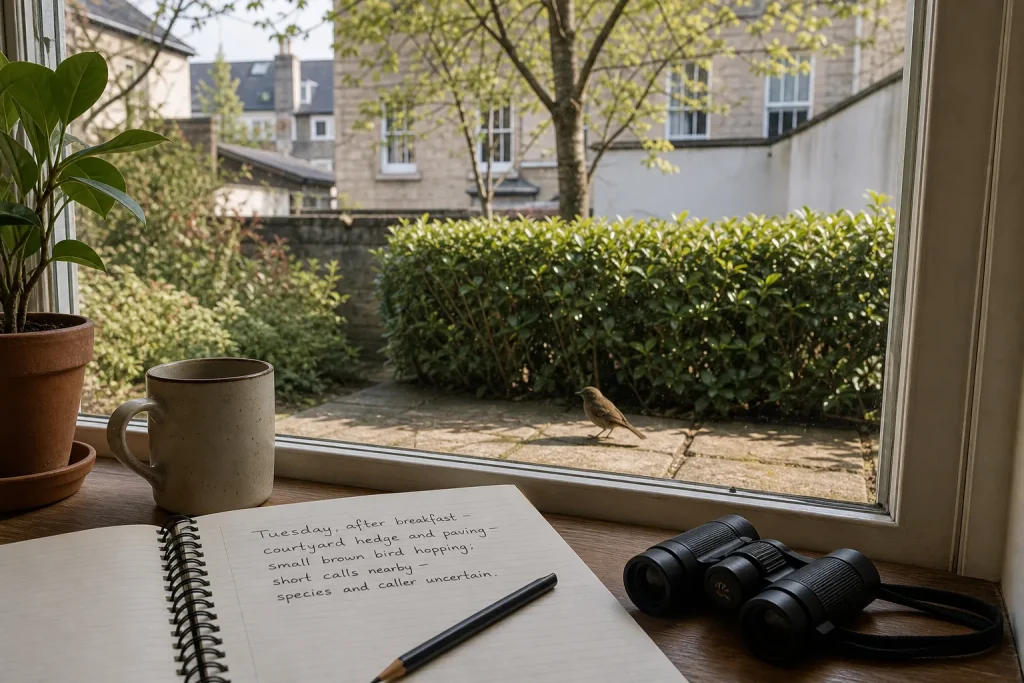
A useful window birdwatch fits into two minutes: choose one view, look without interrupting yourself, then write a brief record before moving on. Repeating the same sequence makes notes easier to compare, even when the only result is that no bird appeared.
Set up one view and one recording place
Choose a safe indoor spot with a clear view of a particular feature, such as a plane tree, roof edge or courtyard hedge. Keep a notebook and pencil there, or open a single note on your phone. Use the same place name each time so later entries refer to the same patch of habitat.
Before starting, decide what counts as an observation: a bird seen, a bird heard, or a deliberate check with no bird noticed. Do not move closer to a nest or lean out of the window for a better view. The routine works from the ordinary view you already have.
Follow the same two-minute sequence
- First half-minute: settle on the chosen view and note the date and approximate time. If you do not know the exact time, write a plain cue such as “after breakfast”.
- Next minute: watch and listen. Notice a visible feature, sound or action. If several birds appear, choose one observation to record rather than trying to track everything.
- Final half-minute: write the place, description, action and uncertainty. If nothing is seen or heard, write “no bird noticed” only if you are keeping a regular log; otherwise leave the page alone.
Keep the entry to one line where possible: “Tuesday, after breakfast — plane tree by bus stop — small brown bird hopping at the base — species unclear.” Describe actions rather than assigning motives. “Carrying dry grass towards the eaves” is an observation; “building a nest” is an interpretation unless you have enough evidence to say so.
Use a short record that separates seeing from guessing
A compact entry needs four parts: time, place, what you saw or heard, and what the bird did. Add an identification only when you are confident. Otherwise, use a description such as “black bird with pale bill” or “repeated high calls from the hedge”. Keep any later identification separate from the original note, so a guess does not replace what you actually observed.
If the view is blocked, record the limit: “calls from behind the hedge; source uncertain”. If the sound could have come from elsewhere, do not assign it to a bird you cannot see. A careful note can still be useful without a species name.
Work through a complete two-minute entry
Say you have a notebook beside a kitchen window overlooking a courtyard hedge. The date is Tuesday, and you start just after breakfast. During the first half-minute, you write “courtyard hedge” and “after breakfast”. In the next minute, you hear several short calls and see a small brown bird hop briefly along the paving, but you cannot make out its markings. In the final half-minute, you record: “Tuesday, after breakfast — courtyard hedge and paving — small brown bird hopping; short calls nearby — species and caller uncertain.” The result is a timed, comparable entry that preserves both what you saw and what you could not confirm; it does not claim the visible bird made the calls.
Use each observation to make a sensible record
- Check whether the same view is visible. If the usual tree or courtyard is in view, keep the established place name; if it is obscured, note “view blocked” rather than switching locations without saying so.
- Check whether you can see identifying features. If the markings are clear enough for a confident identification, record the species; if not, write a plain description and leave the name uncertain.
- Check whether the bird is visible or heard only. If you see it, describe its appearance and action; if you hear a sound without seeing its source, record the sound and mark the caller uncertain.
- Check what action is directly observable. If you can describe feeding, perching or flying, write that action; if you are inferring a purpose, omit it or mark it as tentative.
- Check whether more than one bird is present. If you can distinguish separate birds, record the number only when you are sure; if they overlap or move too quickly, write “several” or leave the count out.
- Check whether a bird appeared during the timed look. If one did, record the observation; if none did and you are keeping a regular log, write “no bird noticed”, otherwise end without an entry.
Keep the routine easy to repeat
Use the same two-minute sequence when it suits your day, not as a reason to watch through every quiet spell. A pencil and paper pad are enough; a phone note works if it stays quick to open and close. Keep descriptions factual, preserve uncertainty and avoid recording conversations if you use a phone to capture sound.
When you review entries, compare like with like: the same named view, similar kinds of notes and observations kept distinct from guesses. That makes a small record clearer without asking it to explain why a bird arrived or disappeared.