A Bird in Three Clues: Shape, Movement, and Sound Before Colour
When glare, distance or poor light hides plumage, compare the bird’s outline, movement and call before settling on a name.
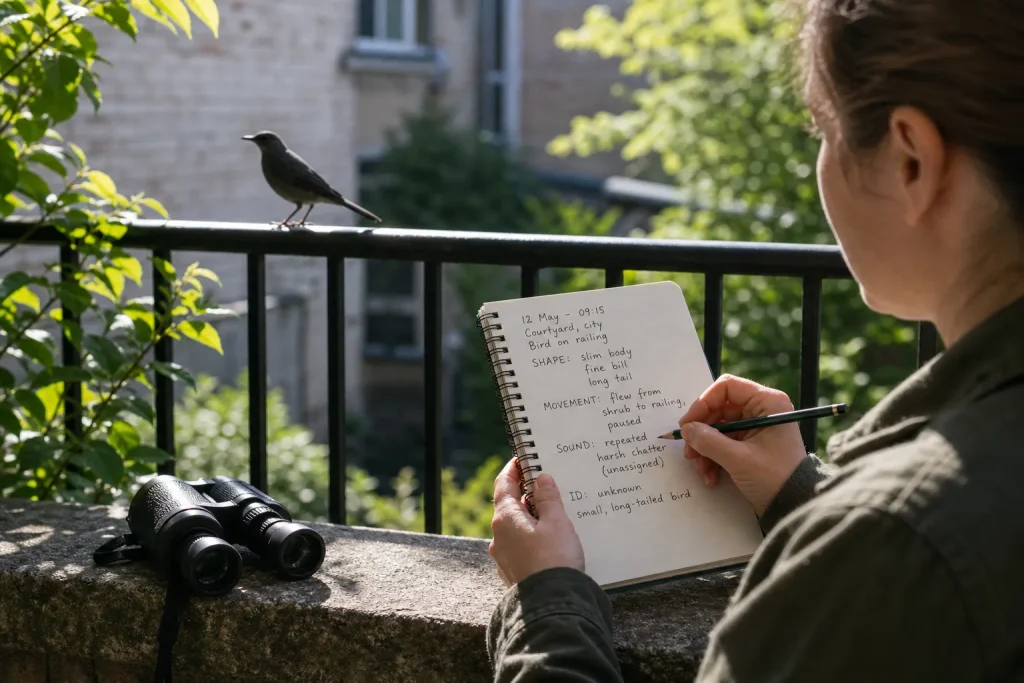
A backlit bird on a rooftop can look like a plain black cut-out, but its outline, movement and call may still offer useful clues. Start by describing what you can actually see, without guessing the species. Then check whether the clues fit together.
Describe the outline before choosing a name
Begin with the whole shape. Is the bird compact or elongated? Does its head look large beside its body? Is the bill short and deep, or fine and pointed? Note the tail’s length and shape if it is visible.
Keep the description neutral. “Small bird with a slim body and long tail” records visible features. “Probably a wagtail” turns an observation into a guess, which can make you overlook clues that do not fit. Add colour only if the light makes it clear.
Posture changes a bird’s outline. A bird crouched while feeding may look rounder than it does when standing upright. If feathers are puffed out or part of the bird is hidden, mark the uncertain feature as unknown rather than filling the gap.
Use a short checklist to record shape
Write down what you can see, then choose a next action based on what is clear. These observations are clues, not rigid rules.
- Body: Check whether it looks plump, slim or elongated. If one shape is clear, compare only guides showing a similar build; if not, record “body shape unclear”.
- Head and neck: Check whether the head looks large or the neck appears long. If either stands out, keep it in your notes; if neither is clear, leave this feature open.
- Bill: Check whether it appears short and stout, fine and pointed, hooked or broad. If the outline is visible, use that shape to rule out a candidate with a plainly different bill; if not, do not use bill shape to decide.
- Tail: Check whether it seems short, long, forked or rounded. If the end is visible, note its shape; if it is hidden, do not infer it from the bird’s movement.
- Legs and feet: Check whether the bird perches, clings or stands on the ground. If the action is clear, record it; if the bird is obscured, leave the posture unknown.
- Wings: If the bird flies, check whether the wings look broad and rounded or narrow and pointed. If the view is brief or blocked, rely on other clues instead.
Watch what the bird does between pauses
Movement can be easier to describe than distant feather detail. Notice whether the bird hops along a branch, walks across the ground, clings to a trunk, hovers briefly or makes short flights between cover and open space.
Look for a repeated pattern rather than treating one gesture as a species label. A bird that repeatedly pauses after a quick dash may be behaving differently from one that moves steadily while probing or picking at food. Note the action in plain words, such as “hops, pauses, then flies to the hedge”.
Record the setting, but do not let it make the identification for you. A bird on a lawn, wall, tree trunk or roof may use different ways of moving, and several kinds of bird can share the same place.
Listen for the type and pattern of the call
Start with broad sound qualities. Is it a single note, a repeated whistle, a dry rattle, a chatter or a short burst of song? Listen for whether the sound repeats from one spot or seems to move with the bird.
Built-up streets can make direction hard to judge. Walls and courtyards reflect calls, while traffic or ventilation can mask quieter notes. If you cannot link a sound to the bird you saw, write “repeated high call from trees” rather than assigning it to that bird.
A phone’s voice recorder can preserve a sound for later comparison. Avoid playing calls aloud to attract a bird; repeated playback can disturb it. A brief note about the sound’s rhythm and tone is often enough to guide a check in a reputable bird guide or sound resource.
Compare the clues without forcing an identification
Keep shape, movement and sound in separate parts of your notes. Then compare a possible identification against each one. A candidate that fits the outline but not a clearly heard call may be wrong, or the call may have come from another bird nearby.
Imagine you see a small bird in a shaded courtyard. Your starting notes are “slim body, fine bill, long tail”; you also see it fly from a shrub to a railing, where it pauses. You hear a repeated harsh chatter, but cannot tell which bird made it. Keep the visual notes together and record the call as unassigned. The result is a useful description for later comparison, while the sound remains an open question.
If the evidence does not support a species name, use a broader label such as “small, long-tailed bird” or “unknown garden bird”. A careful description is more useful than a confident guess that the visible clues cannot support.
Check a field guide or app after making notes
Consult a guide while the sighting is fresh, but first write down your own observations. Use shape drawings and behaviour notes as well as plumage images. With an identification app, compare its suggestions against the features you actually saw rather than accepting the first result.
Check the strongest clues together. If a suggested bird has a stout bill but yours clearly looked fine, treat that mismatch as a reason to reconsider. If the call differs, ask whether it could have come from a second bird before rejecting the visual match.
A local field guide, bird club resource or recording from an established bird organisation can help you compare regional possibilities. Add the date and general location to your notes. If the identification remains uncertain, leave it open; you can revisit the description without having to undo a guess.
Use a changing view to check one missing clue
If the bird turns, look again at its bill or face. If it flies, note the wing outline and flight path. If it calls, listen for the pattern without moving closer. Treat each change as a chance to confirm one detail, not a reason to pursue the bird.
Keep a respectful distance and avoid blocking its route into cover. Binoculars can help from where you are, but a clear silhouette is still worth recording. In a busy street, stay on a safe pavement rather than stepping into traffic or leaning towards the road.
When colour is obscured, a plain description of shape, movement and sound gives you something solid to compare later. Keep uncertain details marked as uncertain; that makes the next observation, not a premature name, the useful next step.